Das weltweite Magazin und der Marktplatz für Oldtimer-Enthusiasten – von Enthusiasten.
Das weltweite Magazin und der Marktplatz für Oldtimer-Enthusiasten – von Enthusiasten.


Filter
Auswahl treffen
- Autos
-
Marke >>
-
Baujahr >>
-
-
Kategorie >>
-
Länder >>
- Motorräder
-
Baujahr >>
-
-
Standort >>
- Teile
-
Automarke >>
-
Hersteller >>
-
Kategorie >>
-
Länder



Jet Age dreams for sale with the Packard Car-A-Van

The 1950s was a time when the American auto industry enjoyed unprecedented prosperity and success. At least, the Big Three car-makers - Ford, Chrysler and General Motors - did. For the handful of independent car-makers, life was getting increasingly difficult as they struggled to compete with the multitude of offerings from the Big Three, whose cars spanned virtually the entire market, from cheap and basic sedans to expensive land yachts of almost unimaginable luxury.
Despite enjoying considerable popularity in the 1930s, in the 1950s Packard's fortunes were to become rather more precipitous. Firmly rooted at the upper end of the market, Packard's customers ranged from the wealthy to the very wealthy and the marque represented the culmination of the American Dream. The trouble was, so did Cadillac, Lincoln and Chrysler, and Packard was no match for them.
Packard's troubles really started in 1954, when it unwisely bought a struggling Studebaker. Around the same time, its problems were compounded by its loss of body-making facilities. In 1940, it had given its body business to Briggs, which in turn was sold to rival Chrysler in 1954.
Still, Packard did what it could, and the way to sell cars to the American public in the 1950s was to dazzle them. This was the age of the dream car, with great stylists such as Harley Earl and Virgil Exner penning outrageous concepts which resembled spacecraft, details from which might trickle through to production cars.
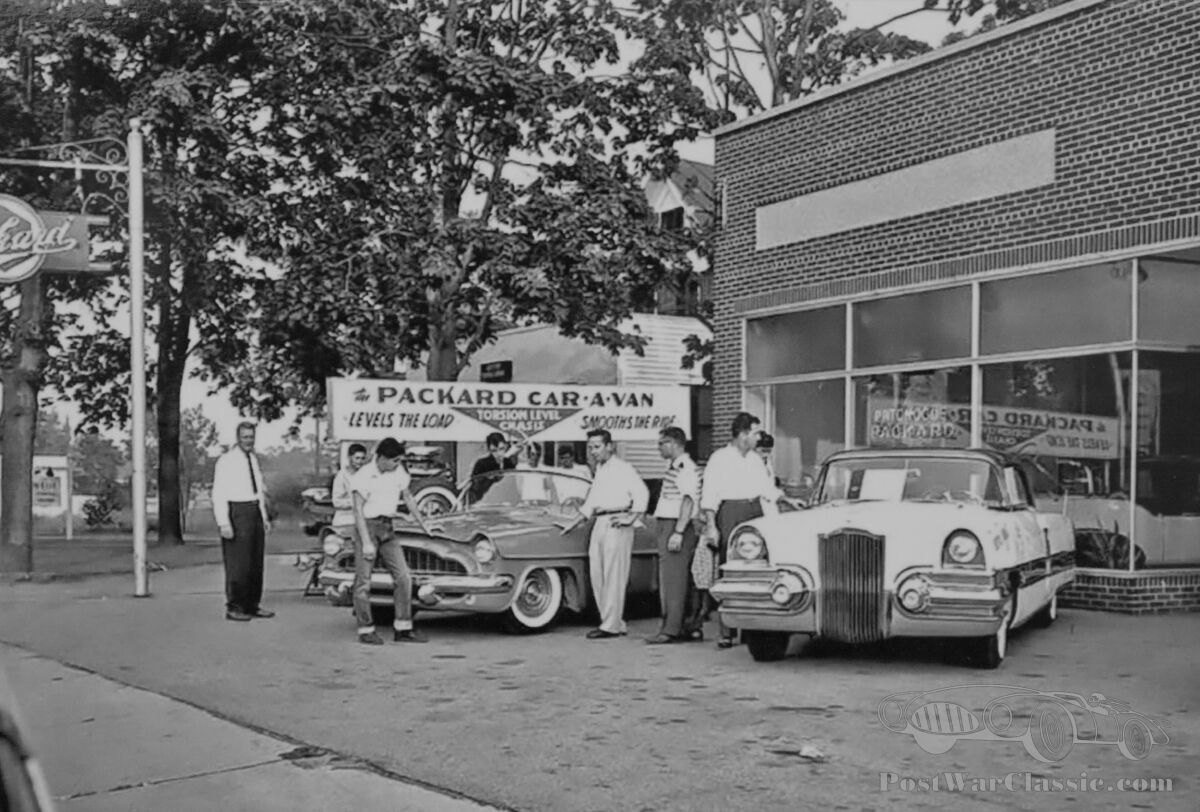
We see here a scene from the 1955 Packard Car-A-Van. The Car-A-Van was an America-wide travelling exhibition of Packard's latest offerings, and the two cars photographed were its show-stoppers. On the left, we see one of the four 1954 Packard Panther concept cars, attractively styled by Dick Teague in something of an Italian idiom, and bodied in fibreglass. The car on the right is a little less impressive. It's the 1955 Packard Request show car, and it resembles an ordinary hardtop with a 1930s-style radiator incongruously stuck on the front, which Teague included at the request of company president James Nance and, apparently, Packard's customer base. It's rather at odds with the futuristic fashions of the time, although there is something about the grille which appears to foreshadow the later trend for 'neo-classics' such as the Stutz Blackhawk.
Apart from the eye-catching looks, the Packards were interesting under the skin, too. Note the banner in the background, which says 'Torsion-Level chasis levels the load, smooths the ride'. Indeed, Packard's all-new Torsion-Level suspension, a complicated electrically-governed system which worked on all four wheels, combined with the introduction of V8 engines to make a car which was uniquely well-engineered.
Alas, neither styling nor engineering could save Packard. It struggled to find financial backing and was bought in 1956 by the Curtiss-Wright Corporation, which turned the last few Packards into badge-engineered Studebakers before consigning the marque to history in 1958.
Words: Zack Stiling
Publiziert:
Donnerstag September 14th, 2023
Facebook
LinkedIn
Twitter
WhatsApp
Email
Copy
Kommentare
Graham Clayton
20 Januar 2024, 02:48
One of my guilty car pleasures is late '70s/early 80s neo-classics - should I get some counselling or therapy?
Weiter lesen