Das weltweite Magazin und der Marktplatz für Oldtimer-Enthusiasten – von Enthusiasten.
Das weltweite Magazin und der Marktplatz für Oldtimer-Enthusiasten – von Enthusiasten.


Filter
Auswahl treffen
- Autos
-
Marke >>
-
Baujahr >>
-
-
Kategorie >>
-
Länder >>
- Motorräder
-
Baujahr >>
-
-
Standort >>
- Teile
-
Automarke >>
-
Hersteller >>
-
Kategorie >>
-
Länder



Flying Cars

Picture courtesy of San Diego Air & Space Museum
Picture courtesy of Barrett-Jackson Auctions



Just as the nascent aircraft industry started to blossom in the first years of the 20th century and as the automobile started its expansion at the same time, there were those visionaries who wanted to combine the two types ― air and land ― into one. Here we show you exampled built after WW2.
Ted Hall
Theodore Parsons "Ted" Hall, an aeronautical structural engineer, designed the Hall XCP1 autoplane in 1939. The "Roadable Airplane" had one wheel at the front, two driven wheels at the rear. With a Mercury V-8 fitted, the machine reached a top speed of 110 mph inflight. Wings and the twin-boom tail could be unbolted in only four minutes with a spanner for road use. He managed to make it fly in 1940 at the Linda Vista airport in San Diego, California. Hall then sold the rights to his invention to the Southern Aircraft Corporation and took a job with the firm, allowing him to continue working on the product’s development. Three prototypes were produced, but due to a lack of funding, the project was dropped before commercial units were built. After WW2 Theodore Hall continued his experiments and developed a new flying car with Tommy Thompson in 1946 for Consolidated Vultee Aircraft (later Convair). The Model 116 was followed by the Model 118, which was equipped with a Crosley engine, powering the plastic-bodied car and a Lycoming engine for the aircraft part. It remained in the prototype stage.
Zuck-Whitaker Planemobile
"Your automobile is a low-flying airplane. Let's take the car off the road and fly where flying is safe ― in the wide blue yonder! An impractical dream? So was flying not so long ago… so was motoring…. [as] the modern car has slavishly imitated the plane in everything except the wings, let's put wings on it and make it fully functional," said Daniel R. Zuck in his book An Airplane in Every Garage, which was published in 1947.
His Planemobile was built together with Stanley Whitaker in 1947, and it looked more like an aircraft than a car. No wonder: Daniel R. Zuck had a hand in designing structural and mechanical details of many top-secret military and commercial aircraft professionally. By means of a shaft, the air-cooled Continental A40 four-cylinder-engine set an oversize tail wheel in motion for driving the Planemobile at the ground. There were no rudders or elevators at its tail; instead the wings had "ailerators," a combination of ailerons and elevators.
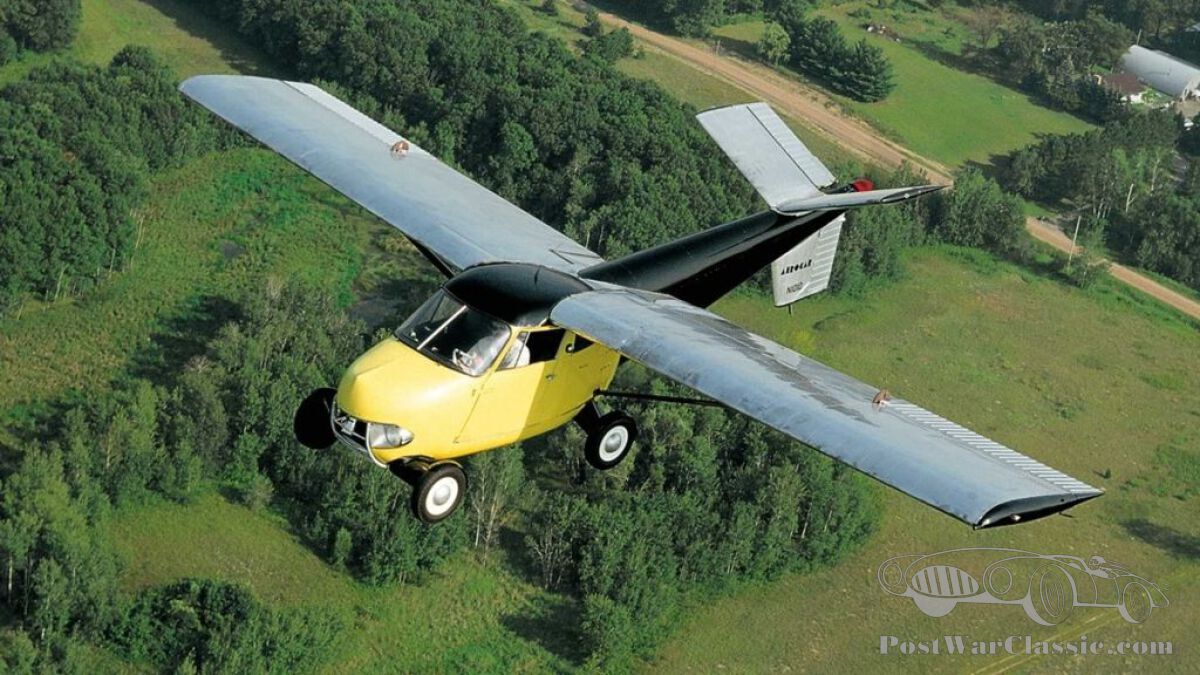
Aerocar
Moulton Taylor founded Aerocar International in the late 1940s, a time when civil aviation was booming thanks to a new generation of pilot strained in World War II. Inspired by Fulton’s Airphibian, he also set out to develop his own practical flying car.
Aerocar International's first effort was the Aerocar I in 1949, which was first flown in 1950. It had a small two-passenger cabin with wheels housed in external airplane-like spats. A Lycoming O-320 horizontally opposed four-cylinder aircraft engine, mounted in the rear of the cabin, produced 143 horsepower and drove the front wheels through a three-speed manual transmission. The Aerocar had a top road speed of 67 mph (107 km/h), while in the air it had a top speed of 110 mph (177 km/h), a 12,000-foot service ceiling, and a range of 300 miles (460 km). What set the Aerocar apart from the Airphibian was that its wings and tail did not have to be left behind at the airport ― they folded into a self-contained package that could be towed behind the car like a trailer.
Taylor was able to secure funding from investors, leading to CAA certification for the Aerocar II in 1956, but while Taylor sold prototypes for $15,000, he was unable to secure a deal for volume production. Only five were constructed, plus a sixth that was built as a flying-only model.
In 1968 Taylor built one more Aerocar, the Aerocar III based on a damaged Aerocar I. It had a more streamlined fiberglass body with enclosed fenders. The wheels were retractable and would be fully extended for take-off and landing, partially retracted for road use and completely retracted in flight. Airspeed was increased to 135 mph (217 km/h). This vehicle is now exhibited at the Museum of Flight in Seattle, Washington.
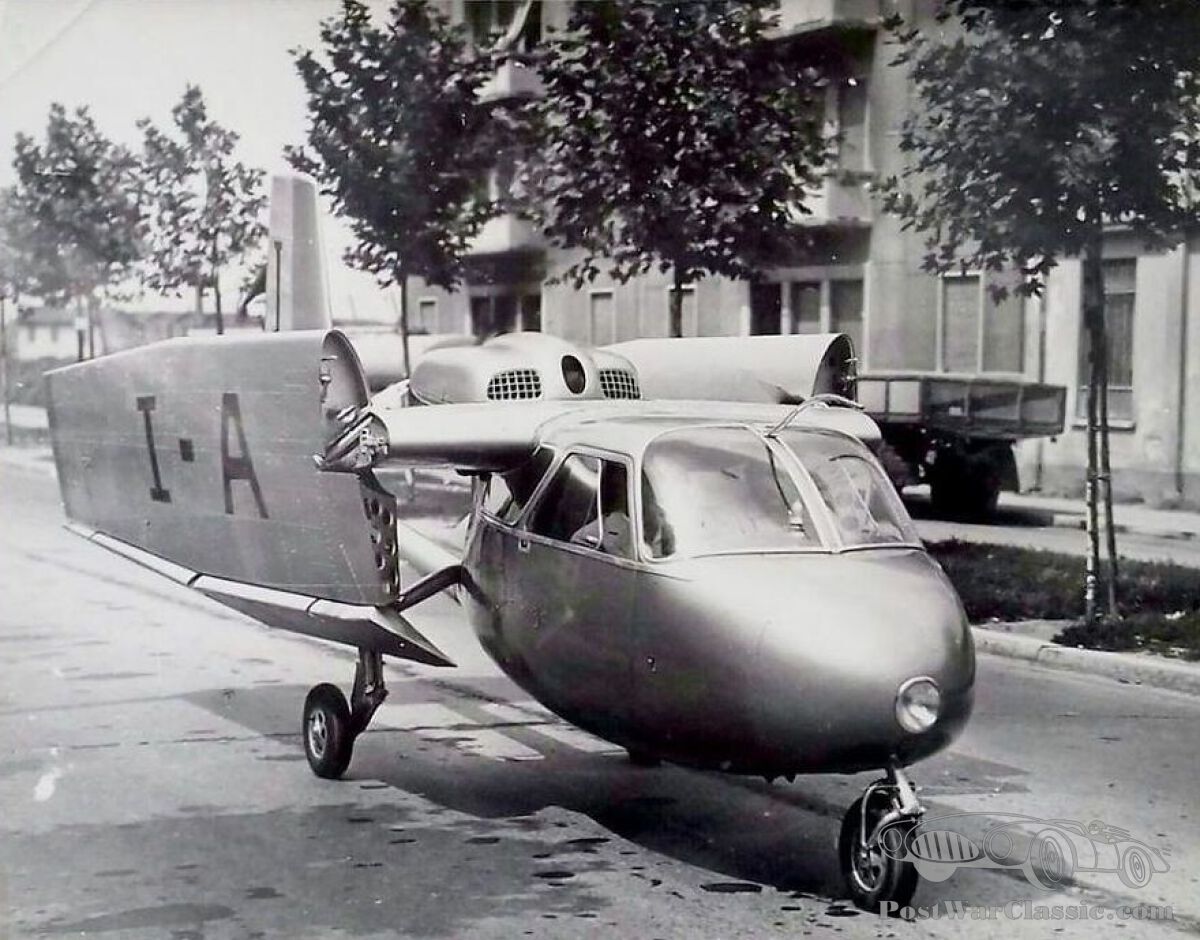
Luigi Pellarini Aerauto
Luigi Pellarini (1913 –2001) was an innovative Italian aircraft designer. By his own account, he built his first flying car right after World War II. He "had made the world’s first flying car in 1945 and for each of the next five years he made a new model," according to a portrait of him in 1952. He claimed he had sold all the models but made very little profit. His last model used its pusher propeller for propulsion not only in the air but also on the road. The Aerauto PL-5C drove and flew across Italy from late 1949 to early 1950, 1800km in the air and 2200 km on the ground. At the promotional tour’ send, Pellarini allowed the Arch bishop of Milan, Cardinal Schuster, to get a look at this sensational flying car.
Simcopter
China-born David Dobbins, whose family moved to San Francisco shortly after his birth, was employed by various aeronautical companies. In the 1950sthe family moved to Mexico, where David taught mathematics at the American school. In his free time he built his Simcopter, which was based on a 1948 Simca 5 combined with a 300-hp Lycoming aircraft engine and a welded superstructure to operate a rotor. On August 15,1957, Dobbins flew his creation for the first and last time. Possibly the Simcopter didn’t work as he had expected.
Halsmer Aero Car
Joseph L. Halsmer of Lafayette, Indiana, a captain with Seaboard World Airlines and the father of 11 children, designed his own unique roadable two-seat aircraft, known as Aero Cars. His last effort, the Aero Car 3, was completed in August1963.It was powered by a 85-hp Continental-flat-four engine, driving a four-blade pusher propeller for propulsion both in the air and on the ground. Wings were able to be folded by one person in just a few minutes. When folded, they lay vertically against the tail-booms, enclosing the propeller to enhance safety while it is driven on the ground.
AVEMizar
In 1971 Henry Smolenski and Harold Blake founded Advanced Vehicle Engineers with the aim of producing the AVE Mirza, a modular roadable flying machine. It was a Ford Pintomated to the rear engine, wings, and tail unit of a Cessna Skymaster. By mid-1973, two prototypes had been built and three more were under construction. For take-off, the Mizar was intended to use both engines to shorten take off roll. On the ground, telescoping wing supports would be extended and the airframe would be tied down like any other aircraft. The Pinto could be quickly unbolted from the airframe and driven away. On September 11,1973, the vehicle disintegrated during testing, killing both of its creators. Development work was immediately stopped.
Despite dozens of failures, the idea of the flying car never died. Paul Moller spent over 30 years trying to bring his life’s work to fruition. In 2017 he even had to sell his original prototype, but there was little interest. Lately Terrafugia in the U.S. and Aeromobil in Slovakia got close to a working model. Terrafugia had to shut down its operations in 2021. But the Aeromobil was certified by the Slovakian authorities recently and it is hoped that by 2024 it will be available commercially.
You can find many more flying cars, 8-wheeler cars and other interesting innovations in the Summer, 2022 issue of Rare & Unique Vehicles! Order your copy today here.
Words by Pal Negyesi.
Publiziert:
Dienstag August 2nd, 2022
Facebook
LinkedIn
Twitter
WhatsApp
Email
Copy