Das weltweite Magazin und der Marktplatz für Oldtimer-Enthusiasten – von Enthusiasten.





Der Markt; alle Post-War fahrzeuge zu verkaufen
Überblick ähnlicher Anzeigen 2024 Land Rover RANGE ROVER 4.4 V8 AUTOBIOGRAPHY
-

1981 Triumph TR7 Convertible to TR8 Specification | Mercedes-Benz World | Historics Auctioneers | 27th November 2021
The TR8 that appeared on the North American market used the all-alloy 3.5 litre V8 engine that had been powering Rovers since 1966. Most of the initial build cars came with dual Zenith Stromberg carburettors - only those sold into emission-conscious California using fuel injection from the outset. Early TR8s were only available in Coupé form - the .. -
1993 Mercedes-Benz 300 GEL | Mercedes-Benz World | Historics Auctioneers | 27th November 2021
The Mercedes-Benz G-Class or G-Wagon, short for Geländewagen (cross-country vehicle), is characterised by its boxy styling and body-on-frame construction. It uses three fully locking differentials, one of the few vehicles to have such a feature. The G-Class is still in production and is one of the longest produced Mercedes-Benz vehicles in their hi.. -
2001 BMW M5 | Mercedes-Benz World | Historics Auctioneers | 27th November 2021
Just like the Jaguar Mk. II had done in the 1960's, the BMW M5, newly introduced for 1998, effectively reinvented the popular notion of a sports saloon. Jaguar had just introduced an XJR with 365bhp, and Mercedes-Benz's latest E55 produced 350bhp so, after a three-year absence, BMW responded last with an automotive knock-out punch: the E39 M5. Its .. -
2004 Aston Martin Vanquish 2+2 | Mercedes-Benz World | Historics Auctioneers | 27th November 2021
An entirely new Aston Martin for the 21st Century, the Vanquish debuted at the Geneva Auto Show in March 2001, with deliveries commencing a few months later. The Vanquish took over from the Vantage V8 with the Newport Pagnell factory undergoing an extensive multi-million pound refurbishment to accommodate it, gaining a new assembly line, paint shop.. -
1992 Mercedes-Benz 200TE | Mercedes-Benz World | Historics Auctioneers | 27th November 2021
The Mercedes-Benz 124 series is a range of mid-size cars made from 1984 to 1997. The range included numerous body configurations, and although collectively referred to as the W-124, official internal chassis designations varied by body style; saloon (W 124). From 1993, the 124 series was officially marketed as the E-Class. This automatic example o.. -
2000 Porsche Boxster S | Mercedes-Benz World | Historics Auctioneers | 27th November 2021
The first-generation Boxster (the 986) was introduced in late 1996; it was powered by a 2.5 litre flat six-cylinder engine. Harm Lagaay's design, inspired by the 356 Speedster and 550 Spyder, stimulated a commercial turnaround for Porsche. Many believe the introduction of the Boxster helped save Porsche from acquisition. It was Porsche's first wate.. -
1994 Mercedes-Benz SL500 | Mercedes-Benz World | Historics Auctioneers | 27th November 2021
Stuttgart supplied these grand-tourers with high levels of comfort including a fabric convertible top as well as a colour-matched and manually detachable hardtop that could be fitted over the stored fabric convertible roof. Other advancements included an electronically controlled damping and the famous hidden, automatically extending roll-over bar... -
1986 Austin Mini Mayfair | Mercedes-Benz World | Historics Auctioneers | 27th November 2021
The Mini was manufactured by the British Motor Corporation (BMC) and its successors from 1959 until 2000. The original is considered a British icon of the 1960s and its space-saving front wheel drive layout that allowed 80% of the area of the car's floorpan to be used for passengers and luggage influenced a generation of car makers. In 1999, the Mi.. -
1984 Mercedes-Benz 230 E | Mercedes-Benz World | Historics Auctioneers | 27th November 2021
The W123 Series surpassed the W114 model range as the most successful Mercedes-Benz ever selling 2.7 million units before production ended in the autumn of 1985 for the saloon versions. Electronic fuel injected engines were introduced in 1980 making the cars faster and more reliable with all cars fitted with power steering from 1982. The build qual.. -
1988 Mercedes-Benz 280 GE | Mercedes-Benz World | Historics Auctioneers | 27th November 2021
The Mercedes-Benz G-Class or G-Wagon, short for Geländewagen, (cross-country vehicle), is characterised by its boxy styling and body-on-frame construction. It uses three fully locking differentials, one of the few vehicles to have such a feature. The G-Class is still in production and is one of the longest produced Mercedes-Benz in Daimler's histor..


Ausgewählt
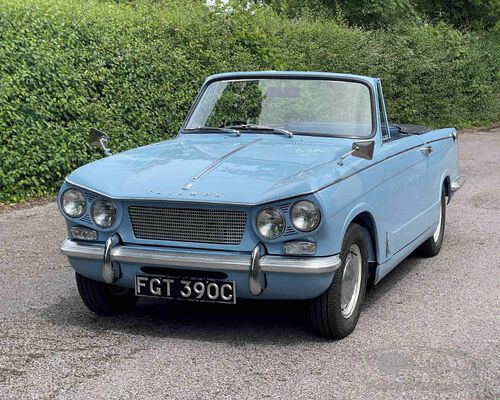
Triumph Vitesse 6 Convertible
Technische DatenMarke & Modell: Triumph Vitesse 6 ConvertibleBaujahr: 1965Zulassung: GroßbritannienFahrgeste..
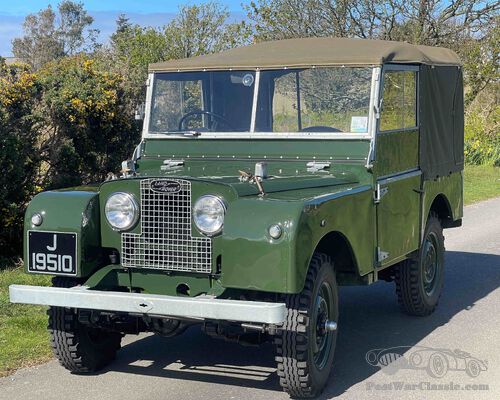
1952 Land Rover Series 1
Technische Daten:Marke und Modell: Land Rover Series !Baujahr: 1952Kennzeichen: Jersey-Zulassung
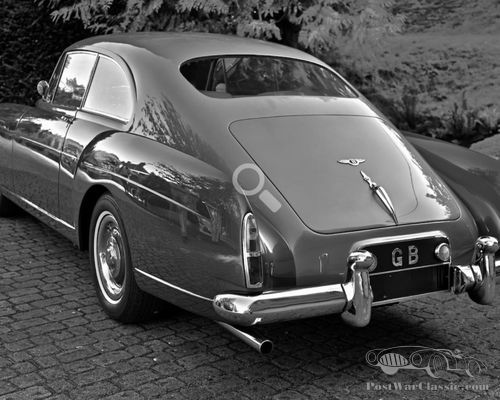
1957 Bentley S1 Fastback durch H.J. Mulliner.
1957 Bentley S1 Fastback by H.J. Mulliner.Frisch restauriertes und preisgekröntes Fahrzeug in neuwertigem Zustand. Es handelt sich um ein sp..