Das weltweite Magazin und der Marktplatz für Oldtimer-Enthusiasten – von Enthusiasten.
Das weltweite Magazin und der Marktplatz für Oldtimer-Enthusiasten – von Enthusiasten.


Auswahl treffen
- Autos
-
Marke >>
-
Baujahr >>
-
-
Kategorie >>
-
Länder >>
- Motorräder
-
Baujahr >>
-
-
Standort >>
- Teile
-
Automarke >>
-
Hersteller >>
-
Kategorie >>
-
Länder



Der Markt; alle Post-War fahrzeuge zu verkaufen
Überblick ähnlicher Anzeigen 1949 Alfa Romeo 6C 2500 Super Sport Cabriolet by Pinin Farina | RM Sotheby's | The Woodcote Park Auction
-

1963 Alfa Romeo Giulia Sprint | Amelia Island Auctions | Gooding & Co | March 2-3, 2023
In 1962, Alfa Romeo updated its 101-Series Giulietta Sprint Coupe. While appearing nearly identical to its predecessor, the new model was rebadged “Giulia” and received a number of improvements. A redesigned dashboard incorporated revamped heating controls and the car featured a three-spoke Bakelite steering wheel and vinyl-covered door panels. ..1963Alfa RomeoGiulia SprintVERKAUFT -
1966 Alfa Romeo Giulia Sprint GT Veloce | Amelia Island Auctions | Gooding & Co | March 2-3, 2023
Launched in 1963, the Alfa Romeo Giulia Sprint GT was designed by Giorgetto Giugiaro for Bertone. The well-proportioned 2+2 coupe carried a distinctive scalino – or “stepnose” – front end where the hood’s leading edge sat above the nose. Largely borrowed from the 105-series sedan, underpinnings included a 1.6-liter, DOHC engine, taut chassis, in..1966Alfa RomeoGiulia Sprint GT VeloceVERKAUFT -
1953 Alfa Romeo 1900C Sprint | Amelia Island Auctions | Gooding & Co | March 2-3, 2023
Presented at the 1950 Paris Motor Show, the Alfa Romeo 1900 was designed by Orazio Satta, a one-time understudy to 1930s Grand Prix engineer Wilfredo Ricart. The marque’s first assembly line-built model, the 1900 utilized unitary construction that specifically allowed coachbuilders to re-body it. Advertised as “the family car that wins races,” t..1953Alfa Romeo1900C SprintVERKAUFT -
1973 Alfa Romeo 1600 Junior Zagato | Amelia Island Auctions | Gooding & Co | March 2-3, 2023
Designed by Zagato’s Ercole Spada and debuted at the 1969 Torino Motor Show, the Junior Zagato satisfied Alfa Romeo’s desire for a more sophisticated and upscale alternative to the Giulia GT coupe. Initially powered by a 1,300 cc engine, the 1,600 cc derivative was launched for the 1972 model year, allowing use of the entire Giulia Spider floor ..1973Alfa Romeo1600 Junior ZagatoVERKAUFT -
1995 Alfa Romeo 155 D2 Superturismo | Amelia Island Auctions | Gooding & Co | March 2-3, 2023
The Italian Superturismo Championship was started in 1987 as Italy’s national motor sports series for touring cars. Originally run using FIA’s Group A specification, the series shifted to the new Superturismo category of cars in the early 1990s. Alfa Romeo brought its rich history in racing to the Superturismo series with a variant of its 155 se..1995Alfa Romeo155 D2 SuperturismoVERKAUFT -
1949 Alfa Romeo 6C 2500 Super Sport Cabriolet | Amelia Island Auctions | Gooding & Co | March 2-3, 2023
The 6C 2500, introduced in 1938, was the final Alfa Romeo model powered by a Vittorio Jano-designed engine. Jano’s six- and eight-cylinder engines, some of the most revered in the automotive world, powered Alfa Romeo’s finest offerings before and after WWII. At the top of the 6C 2500 range was the Super Sport model, or SS, which benefited from a..1949Alfa Romeo6C 2500 Super Sport CabrioletVERKAUFT -
1973 Alfa Romeo Montreal | Amelia Island Auctions | Gooding & Co | March 2-3, 2023
Introduced at the 1970 Geneva Motor Show, the Alfa Romeo Montreal was a sleek 2+2 front-engine, rear-wheel drive coupe designed by Marcello Gandini of Bertone. Derived from the exotic Tipo 33 Stradale, the Montreal’s 2.6-liter, quad-cam V-8 with Spica mechanical fuel injection and dry-sump lubrication was mated to a five-speed ZF manual gearbox...1973Alfa RomeoMontrealVERKAUFT -
1968 Alfa Romeo Giulia Sprint GTA 1300 Junior Stradale | Amelia Island Auctions | Gooding & Co | March 2-3, 2023
The 1960s saw a second golden age in the competition history of Alfa Romeo. Models such as the SZ, TZ, and TZ2, along with the Tipo 33 sports racing prototypes, made Alfa Romeo a potent force on the world’s circuits. The exciting production racing classes were not ignored either, with the 105-series Giulia Sprint GT providing the base for a high..1968Alfa RomeoGiulia Sprint GTA 1300 Junior StradaleVERKAUFT -
1956 Alfa Romeo Giulietta Sprint | Amelia Island Auctions | Gooding & Co | March 2-3, 2023
Alfa Romeo introduced the Giulietta Sprint at the 1954 Torino Motor Show. Designed by Franco Scaglione of Bertone, the handsome 2+2 coupe was technically advanced for the period and featured an independent front suspension, live rear axle, and coil springs with hydraulic dampers at all four corners. Powered by an alloy 1.3-liter four-cylinder en..1956Alfa RomeoGiulietta SprintVERKAUFT -
1947 Willys CJ-2A | Amelia Island Auctions | Gooding & Co | March 2-3, 2023
Immediately following WWII, the CJ-2A was introduced as the first civilian jeep with the 134 cid “Go Devil” engine and robust T-90A three-speed gearbox. The military model was updated with a tailgate, side-mounted spare tire, and larger headlights, and was marketed as a farm vehicle. However, the CJ-2A soon became synonymous with off-road advent..1947WillysCJ-2AVERKAUFT


Ausgewählt
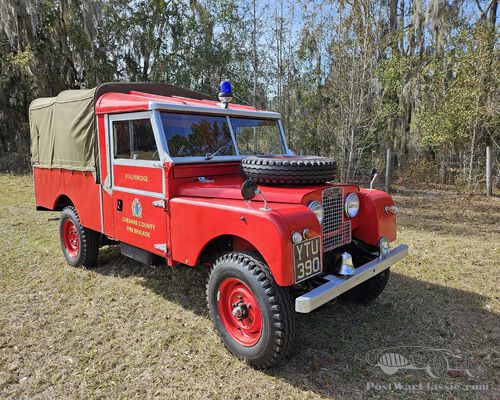
1957 Series 1 Land Rover Fire Engine + Coventry Climax Godiva Fire Pump
Betsy was used by Cheshire Fire Service (UK) from 1957 to 1975. She was based at Hazel Grove and Stalybridge Fire stations. She comes with an exten..

Rolls-Royce
Rolls-Royce Silver Wraightlinks gestuurd, automatic, stuurbekrachtigingkleur antraciet grijs, lopende auto op Nederlands kenteken
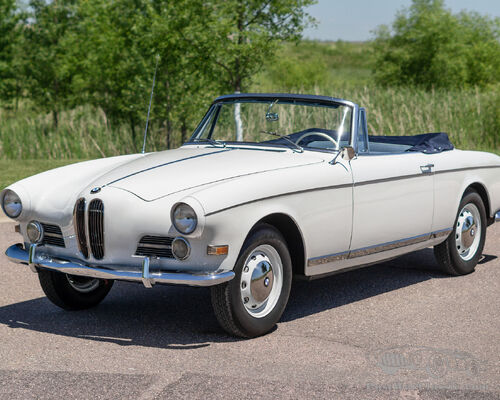
1957 BMW 503 Cabriolet (V8) – 1 von 13 für den US-Markt gebaut – #Matching Exemplar
1957 BMW 503 Cabriolet Serie 1Originaler Aluminium-V8 # MatchingOriginale Aluminiumkarosserie mit Werksprägungen1 von..