Das weltweite Magazin und der Marktplatz für Oldtimer-Enthusiasten – von Enthusiasten.





Der Markt; alle Post-War fahrzeuge zu verkaufen
Überblick ähnlicher Anzeigen 1976 Alfa Romeo Sports Coupé by Autotecnica del Lario | RM Sotheby's | The Woodcote Park Auction
-

1961 Ghia L6.4 | Pebble Beach Auctions | Gooding & Company
Eugene Casaroll’s vision to create a Ghia-bodied, ultra-luxury car with modern American running gear that catered to the world’s wealthy and famous is a well-known success story. The 117 Dual-Ghia convertibles built were the very definition of style and exclusivity. Following the successful run of the convertibles, noted for their association wi.. -
1967 Toyota 2000 GT | Pebble Beach Auctions | Gooding & Company
By the mid-1960s, the burgeoning Japanese auto industry had become adept at producing small-displacement, economical cars, but struggled to gain respectability as a sports car manufacturer. That would change with the development of the Toyota 2000 GT, which brought divergent companies together to build, in limited numbers, a beautiful grand tour.. -
1967 Volkswagen 'Double Slider' Deluxe Microbus | Pebble Beach Auctions | Gooding & Company
Built in its final model year, this supremely rare and desirable 1967 Deluxe Samba Type 2 T1 Microbus features the 21-window design with a twotone paint scheme, 12-volt electrics, and deluxe trim. Delivered new to Oldenburg, Germany, it was built with what is likely the rarest combination of factory options, including double-sliding side doors, .. -
1964 Porsche 356 C Carrera 2 Cabriolet | Pebble Beach Auctions | Gooding & Company
Introduced in 1962, the 2000 GS – or Carrera 2 – was created to meet customer demand for a four-cam Porsche with greater mid-range power and torque. The early four-cam engines, with their roller-bearing crankshafts, produced power high in the rpm range, a characteristic acceptable for the lightweight Spyder models; however, for a 356-based sport.. -
1962 Ferrari 400 Superamerica Series I Coupé Aerodinamico | Pebble Beach Auctions | Gooding & Company
At the 1960 Brussels Motor Show, Ferrari unveiled the latest evolution of its traditional, top-of-the-range gran turismo – the 400 Superamerica. Although it retained the hallowed Superamerica moniker of the previous 410 series, the new car shared little with its predecessor. To begin with, the 400 SA chassis was based largely on the wel.. -
1968 Lamborghini Miura P400 | Pebble Beach Auctions | Gooding & Company
The Miura presented here, chassis 3378, is a magnificently restored example of the original P400 model, the purest version of Lamborghini’s groundbreaking supercar. Bearing production no. 147 and engine no. 1739, this Miura was originally finished in vibrant Rosso Miura (Miura Red) over black vinyl upholstery – the same color scheme see.. -
1962 Parilla 250 Grand Sport | Pebble Beach Auctions | Gooding & Company
Parilla’s origins date to the immediate postwar period when founder Giovanni Parrilla dropped one “r” from his last name for the company moniker and began building innovative racing motorcycles. Introduced in the late 1950s, the Grand Sport model was the company’s top offering, featuring an exotic bevel-drive overhead cam engine. The hi.. -
1960 Ferrari 250 GT Series II Cabriolet | Pebble Beach Auctions | Gooding & Company
The Ferrari presented here, chassis 1817 GT, is a very special example of the Series II Pinin Farina Cabriolet, of which only 200 were built between 1959 and 1962. Designed and built by Carrozzeria Pinin Farina, the beautifully finished Cabriolet was the most refined model in the 250 GT range and, with a price of 5,800,000 lire, it was also the .. -
1967 Ferrari 330 GTC | Pebble Beach Auctions | Gooding & Company
Introduced at the Geneva International Motor Show in 1966, the Ferrari 330 GTC bridged the gap between an aggressive sports car and refined grand tourer. Integrating styling elements of Ferrari’s limited-production, coachbuilt models with mechanical innovations that had debuted on the 275 GTB and GTS models, the 330 GTC was among the first Ferra.. -
1960 Porsche RS60 | Pebble Beach Auctions | Gooding & Company
Unveiled in January 1960, the RS60 represented the ultimate evolution of Porsche’s aluminum-bodied, four-cam Spyder – an iconic series of sports racing cars originating with the Type 550 of 1953. The RS60 was, in essence, a refined version of the highly successful works RSKs built for the 1959 racing season. While the RS60 maintained th..


Ausgewählt
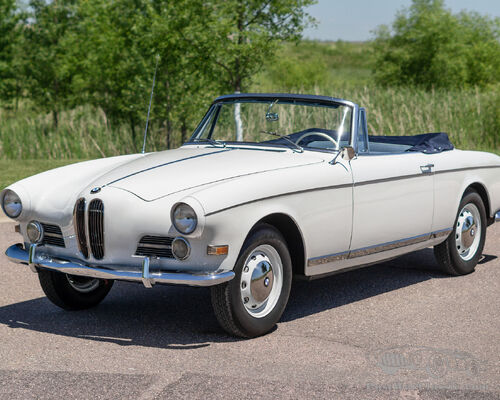
1957 BMW 503 Cabriolet (V8) – 1 von 13 für den US-Markt gebaut – #Matching Exemplar
1957 BMW 503 Cabriolet Serie 1Originaler Aluminium-V8 # MatchingOriginale Aluminiumkarosserie mit Werksprägungen1 von..