Das weltweite Magazin und der Marktplatz für Oldtimer-Enthusiasten – von Enthusiasten.





Der Markt; alle Post-War fahrzeuge zu verkaufen
Überblick ähnlicher Anzeigen 1976 Alfa Romeo Sports Coupé by Autotecnica del Lario | RM Sotheby's | The Woodcote Park Auction
-

1964 Mercedes-Benz 230SL Pagoda | Historics Auctioneers
The Mercedes-Benz W113 roadsters, designed by Paul Bracq, were produced from 1963 through to 1971 and were known as the 'pagoda roof' SL. All models boast an inline six-cylinder engine with multi-port fuel injection. Rear-wheel drive configuration was complemented by independent rear suspension, a feature that greatly improved road handling. The 23.. -
1967 Jaguar E-Type Series I Roadster to Lightweight Specification | Historics Auctioneers
According to the Jaguar Heritage Trust certificates, chassis 1E15625 was originally sold through Jaguar Cars in New York to Shirley Edghill in 1967. Little is known during the intervening years until the story is picked up again in the 1990s. It was exported from the USA to Toulouse in France in 1996 by Jacques Baron working in collaboration with M.. -
1968 MG C Roadster | Historics Auctioneers
The MGC was the first 'high performance' version of the MGB. From early in the design stages of the MGB there was an intention to create high performance variants, using a range of Vee engines that did not make it to production. The MGC was much more than a tuned MGB, in fact it was a completely re-engineered car, but retained many visual connectio.. -
1990 Alfa Romeo Spider S4 | Historics Auctioneers
The Spider designation for the open top sports cars originates from the word, speeder, and a two-person open horse carriage. The Alfa Romeo 105/115 Series Spider was produced from 1966 to 1993, remaining in production for almost three decades with only minor aesthetic and mechanical changes. Widely regarded as a design classic, this fourth series v.. -
1966 Mercedes-Benz 230 SL | Historics Auctioneers
Launched at the Geneva Motor Show in March of 1963, the 230 SL was a very different car to its predecessors. Intended as the replacement for the 190 SL, the 230 SL abandoned the four-cylinder engine in favour of a 2.3 litre fuel-injected, six-cylinder engine, producing 150bhp. The new engine was derived from that of the great 220 SE. The Paul Bracq.. -
1968 MG B Roadster | Historics Auctioneers
The MGB was launched in May 1962 to replace the MGA. Introduced as a four-cylinder roadster, a coupé with 2+2 seating was added in 1965. It was a relatively modern design at the time of its introduction, utilising a monocoque structure instead of the traditional 'body-on-frame' construction used on both the MGA and MG T-Types. The lightweight desig.. -
1963 Jaguar E-Type Series I Coupé (3.8 Litre) | Historics Auctioneers
In 1958, Jaguar technical director, William Heynes, and designer, Malcolm Sayer, convinced their boss, Sir William Lyons, that a new production sports model was needed. Thus, the E-Type was born; one of Jaguar's longest-running and most revered models. Much of the E-Type’s success was owed to the racing D-Type and, indeed, it would be one of the la.. -
1965 Mercedes-Benz 230 SL Pagoda | Historics Auctioneers
The Mercedes-Benz W113 roadsters, designed by Paul Bracq, were produced from 1963 through to 1971 and were known as the 'pagoda roof' SL. All models boast an inline six cylinder engine with multi-port fuel injection. Rear wheel drive configuration was complemented by independent rear suspension, a feature that greatly improved road handling. The 23.. -
1964 Alfa Romeo Giulia Sprint GT | Historics Auctioneers
The Alfa Romeo Giulia (105) Sprint GT was designed by Bertone’s Giorgetto Giugiaro. The car was launched in September 1963 at the newly opened Arese plant, and displayed later that month at the Frankfurt Motor Show. The overall styling of the Giulia was kept very simple however, the Giulia had a very distinctive Scalino “step front” design with the.. -
1966 TVR 400 | Historics Auctioneers
The TVR Griffith Series 400 is a two-door sports car produced by Griffith Motor Company in Plainview, New York , between 1964 and 1967. It was the successor to the TVR Griffith 200 featuring improved cooling via a larger radiator with twin electric fans, redesigned rear suspension, and a redesigned rear with better visibility and the round tailligh..


Ausgewählt
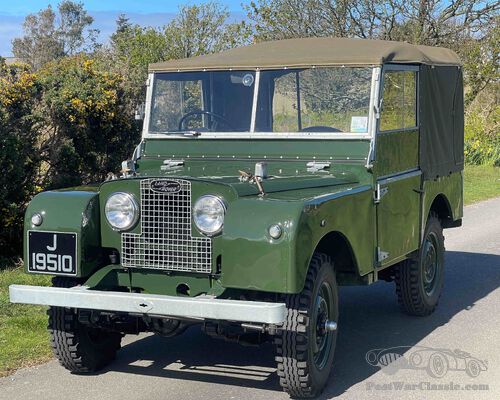
1952 Land Rover Series 1
Technische Daten:Marke und Modell: Land Rover Series !Baujahr: 1952Kennzeichen: Jersey-Zulassung
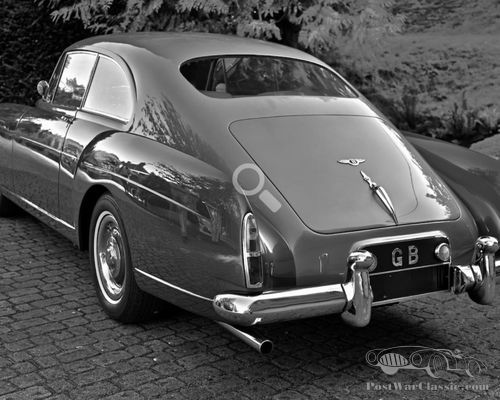
1957 Bentley S1 Fastback durch H.J. Mulliner.
1957 Bentley S1 Fastback by H.J. Mulliner.Frisch restauriertes und preisgekröntes Fahrzeug in neuwertigem Zustand. Es handelt sich um ein sp..
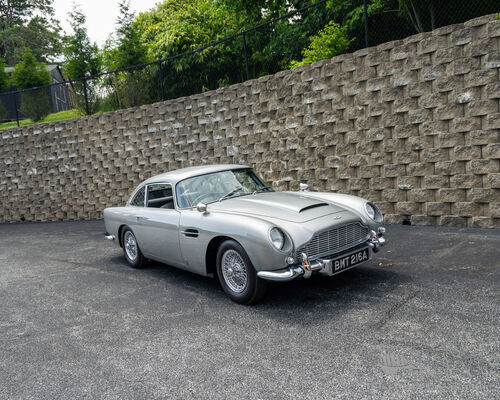
2020 Aston Martin DB5 Goldfinger Continuation
Angeboten bei RM Sotheby's, The Monterey Auction, 13.–15. August 2026. Schätzpreis: 1.000.000–1.500.000 USDEines von ledi..