Das weltweite Magazin und der Marktplatz für Oldtimer-Enthusiasten – von Enthusiasten.





Der Markt; alle Post-War fahrzeuge zu verkaufen
Überblick ähnlicher Anzeigen 1970 Mini 850 - TÜV neu - seltene Spanien Version - fahrbereit
-

1970 Mercedes-Benz 280 SL Pagoda Restoration | Historics Auctioneers | Nov 26, 2022
The Mercedes-Benz 280 SL was introduced in December 1967 and continued in production until February 1971. An all new design by Paul Bracq to replace the 190 SL and 300 SL Roaster. The 280 SL had a powerful 2.8 litre version of Mercedes inline-six and used Bosch fuel injection. To save on weight the bonnet, boot lid and tonneau cover were all compos.. -
1973 BMW 2002 Tii | Historics Auctioneers | Nov 26, 2022
BMW's director of product planning, Helmut Werner Bönsch and Alex von Falkenhausen, the designer of the BMW M10 engine, had both been owners of a 1600-2 (1602) and subsequently both had installed a two-litre engine in their respective cars. Following the realisation that they had both made the same modification, they prepared a joint proposal to BM.. -
1972 Rolls-Royce Phantom VI | Historics Auctioneers | Nov 26, 2022
Introduced alongside the Silver Cloud II and Bentley S2 in the Autumn of 1959, Rolls-Royce's new limousine model, the long-wheelbase Phantom V, effectively replaced both the royalty/heads-of-state-only Phantom IV and the Silver Wraith. The latter's relatively short wheelbase (for a limousine) had made it all but impossible for coachbuilders to prov.. -
1972 Jensen Interceptor SP Mk. III | Historics Auctioneers | Nov 26, 2022
Alan and his brother Richard Jensen first became involved with car design and construction in 1925 when their efforts to improve on the styling and performance of an Austin Seven Chummy attracted much favourable attention. A few Jensen-bodied Fords were produced in the mid-1930s before a more serious manufacturing effort commenced in 1938. After Wo.. -
1972 Jaguar E-Type Series III 2+2 Fixedhead Coupé | Historics Auctioneers | Nov 26, 2022
The Series III fulfils a roll in the E-Type line-up missed by previous generations by adding 6” into the wheelbase thus allowing the more mature and taller driver to enjoy the visceral experience first penned by Jaguar’s chief designer back with the Series I in the mid-1960s. Albeit now with a smother 12-cylinder power plant, generally more space a.. -
1972 MG B GT | Historics Auctioneers | Nov 26, 2022
The MGB was first introduced in May 1962 as a direct replacement for the MGA. Performance was brisk with power supplied by a 1798cc four-cylinder iron block engine set within a monocoque lightweight bodyshell with crumple zones incorporated. October 1965 saw the introduction of the GT and was based on the already popular roadster. Designed by Pinin.. -
1971 Triumph Stag | Historics Auctioneers | Nov 26, 2022
Stylish, fast and practical, the Stag began life as a Triumph 2000 based styling exercise by Italian carrossier, Giovanni Michelotti. A 2+2 convertible, Michelotti's design featured a quad-lamp grille and sculpted front and rear ends, the latter destined to appear on many future Triumphs. By the time production commenced in 1970, the 2000's six-cyl.. -
1972 Lotus Europa Twin Cam ‘John Player Special’ | Historics Auctioneers | Nov 26, 2022
Launched in 1966, the Lotus Europa was the first mass production, mid-engine road car and was based on a prototype built to compete for a Ford contract to build a Le Mans race car in the early 1960s. Exemplifying Colin Chapman's design philosophy of ‘simplify, then add lightness,’ it used a minimalist steel backbone chassis while also relying on a .. -
1970 Jaguar E-Type Series II Coupé | Historics Auctioneers | Nov 26, 2022
From its launch in 1961 to the end of its production in 1975, the Jaguar E-Type went from design revelation to motoring icon in a generation. Based on Jaguar’s three time Le Mans winning D-Type and known internationally for its beautiful sleek lines and a top speed of 150mph, this revolutionary car had three significant series changes during its 14.. -
1973 De Tomaso Pantera | Historics Auctioneers | Nov 26, 2022
De Tomaso's replacement for their successful Mangusta in 1971 was the avant-garde and stylish Pantera. Maintaining the best of the ingredients from the Mangusta, including the mid-mounted 300 horsepower, Ford 351ci, V8 Cleveland engine, five-speed ZF transaxle and dramatic styling, the Pantera also added monocoque construction into the mix, the fir..


Ausgewählt
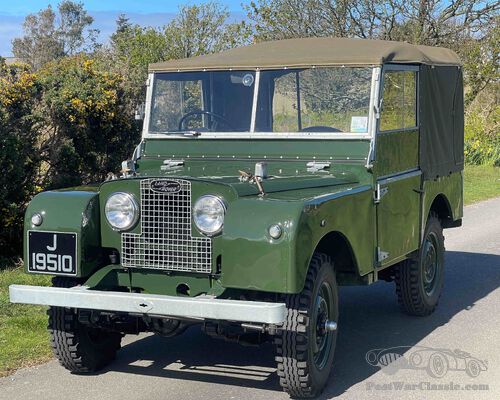
1952 Land Rover Series 1
Technische Daten:Marke und Modell: Land Rover Series !Baujahr: 1952Kennzeichen: Jersey-Zulassung
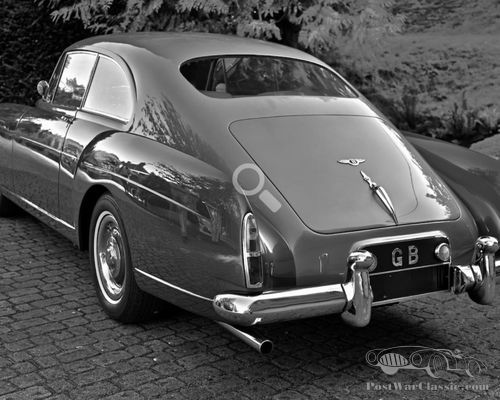
1957 Bentley S1 Fastback durch H.J. Mulliner.
1957 Bentley S1 Fastback by H.J. Mulliner.Frisch restauriertes und preisgekröntes Fahrzeug in neuwertigem Zustand. Es handelt sich um ein sp..
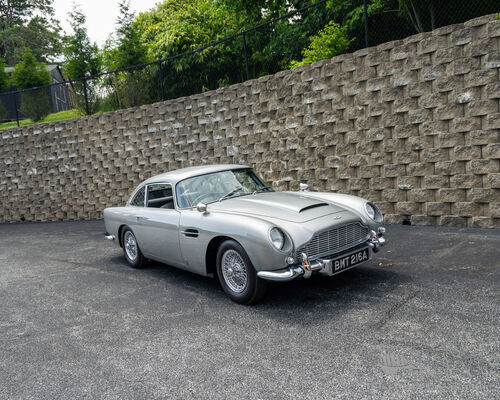
2020 Aston Martin DB5 Goldfinger Continuation
Angeboten bei RM Sotheby's, The Monterey Auction, 13.–15. August 2026. Schätzpreis: 1.000.000–1.500.000 USDEines von ledi..