Das weltweite Magazin und der Marktplatz für Oldtimer-Enthusiasten – von Enthusiasten.





Der Markt; alle Post-War fahrzeuge zu verkaufen
Überblick ähnlicher Anzeigen 1970 Mini 850 - TÜV neu - seltene Spanien Version - fahrbereit
-

1979 Pontiac Firebird Trans Am | Amelia Island Auctions | Gooding & Co | March 2-3, 2023
1979 saw a major transformation for Pontiac’s beloved Firebird, featuring a completely restyled body with improved aerodynamics, larger fender flares, and an enhanced rear spoiler. It also marked the end of the line for big-block V-8s from Pontiac with the optional 400 cid W72 V-8 engine. Claimed by Pontiac to produce 220 hp and 320 lbs./ft. of .. -
1973 Porsche 911 Carrera RS 2.7 Touring | Amelia Island Auctions | Gooding & Co | March 2-3, 2023
First developed to homologate the 911 for Group 4 racing, the Carrera RS 2.7 marked many firsts for Porsche. Launched in 1972, customers could choose from Touring and Lightweight models, both of which offered significant performance and weight savings over the standard 911S. Weight savings came by way of lighter-gauge sheet metal, thinner window.. -
1971 Mercedes-Benz 280 SE 3.5 Coupe | Amelia Island Auctions | Gooding & Co | March 2-3, 2023
Created in the Mercedes-Benz tradition of quality, engineering, and luxury, the W111 generation reached its pinnacle with the 280 SE 3.5. It introduced V-8 power to a Mercedes-Benz Coupe for the first time, adding heightened performance to the car’s virtues and furthering the heritage of the prestigious firm. This 3.5 Coupe was original.. -
1973 Ferrari 365 GTB/4 Daytona Spider | Amelia Island Auctions | Gooding & Co | March 2-3, 2023
Debuted in Paris in 1968, the 365 GTB/4 succeeded the 275 GTB/4 as Ferrari’s new top-of-the-line, two-seat gran turismo. Almost immediately, it was unofficially known as the “Daytona” in honor of Ferrari’s podium sweep at the 24 Hours of Daytona in 1967, and it stands as the last front-engine, V-12 GT model designed before Fiat’s takeov.. -
1973 Alfa Romeo 1600 Junior Zagato | Amelia Island Auctions | Gooding & Co | March 2-3, 2023
Designed by Zagato’s Ercole Spada and debuted at the 1969 Torino Motor Show, the Junior Zagato satisfied Alfa Romeo’s desire for a more sophisticated and upscale alternative to the Giulia GT coupe. Initially powered by a 1,300 cc engine, the 1,600 cc derivative was launched for the 1972 model year, allowing use of the entire Giulia Spider floor .. -
1970 Citroën Méhari | Amelia Island Auctions | Gooding & Co | March 2-3, 2023
Named after a swift dromedary camel, Citroën’s Méhari was an elemental and lightweight recreational and utility vehicle, based on the chassis and mechanicals of the 2CV. In fact, the Méhari was quite similar in concept to BMC’s Mini-derived Mini Moke. In addition to the innovative chassis and suspension design of the 2CV, the Méhari featured a u.. -
1976 Porsche 930 | Amelia Island Auctions | Gooding & Co | March 2-3, 2023
Having established their reputation with lightweight, naturally aspirated, well-handling sports cars, the 930 marked a large departure from their original recipe for Porsche. Under its flared fenders and the iconic “whale tail” spoiler was a turbocharged flat-six, which produced nearly 250 bhp. Not meant for the faint of heart, the single KKK tu.. -
1976 Ferrari 308 GTB Vetroresina | Amelia Island Auctions | Gooding & Co | March 2-3, 2023
Introduced at the 1975 Paris Motor Show, the mid-engine, two-seater Ferrari 308 GTB featured a 2.9-liter DOHC V-8, five-speed transaxle, independent suspension, and four-wheel disc brakes. Bodywork was fabricated from fiberglass – vetroresina in Italian – until June 1977. This 1976 Ferrari 308 GTB is one of 712 Vetroresinas built and on.. -
1973 Alfa Romeo Montreal | Amelia Island Auctions | Gooding & Co | March 2-3, 2023
Introduced at the 1970 Geneva Motor Show, the Alfa Romeo Montreal was a sleek 2+2 front-engine, rear-wheel drive coupe designed by Marcello Gandini of Bertone. Derived from the exotic Tipo 33 Stradale, the Montreal’s 2.6-liter, quad-cam V-8 with Spica mechanical fuel injection and dry-sump lubrication was mated to a five-speed ZF manual gearbox... -
1974 Volkswagen Karmann Ghia Convertible | Amelia Island Auctions | Gooding & Co | March 2-3, 2023
Originally designed by Carrozzeria Ghia of Torino and built by Karmann of Osnabrück, Germany, the Karmann Ghia Coupe debuted at the 1955 Paris Motor Show where it found immediate popularity, and a convertible variant was introduced just two years later. Production continued with minimal changes until 1974, when it was replaced by the Golf-based..


Ausgewählt
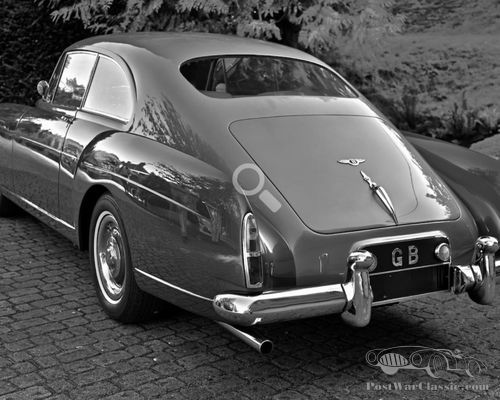
1957 Bentley S1 Fastback durch H.J. Mulliner.
1957 Bentley S1 Fastback by H.J. Mulliner.Frisch restauriertes und preisgekröntes Fahrzeug in neuwertigem Zustand. Es handelt sich um ein sp..
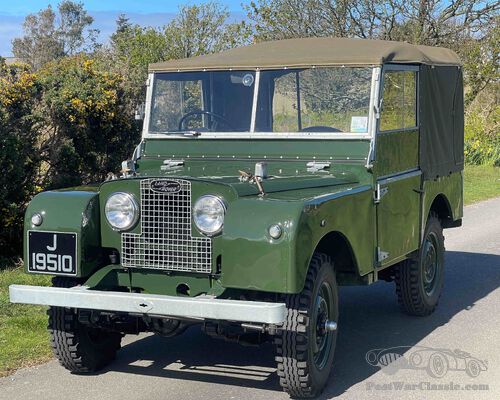
1952 Land Rover Series 1
Technische Daten:Marke und Modell: Land Rover Series !Baujahr: 1952Kennzeichen: Jersey-Zulassung
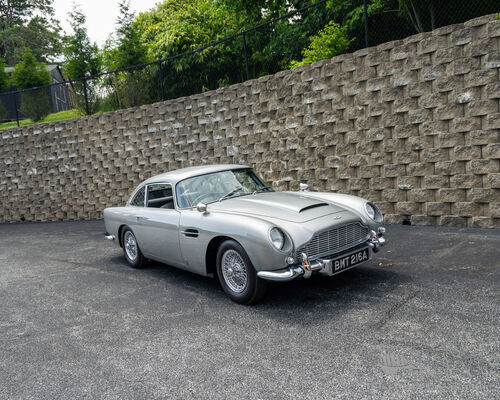
2020 Aston Martin DB5 Goldfinger Continuation
Angeboten bei RM Sotheby's, The Monterey Auction, 13.–15. August 2026. Schätzpreis: 1.000.000–1.500.000 USDEines von ledi..