Das weltweite Magazin und der Marktplatz für Oldtimer-Enthusiasten – von Enthusiasten.





Der Markt; alle Post-War fahrzeuge zu verkaufen
Überblick ähnlicher Anzeigen 1972 Ferrari 365 GTC4 by Pininfarina
-

2005 Ferrari 612 Scaglietti | Historic Auctioneers | Farnborough International | 11th May 2024
The Scaglietti 2+2 Coupé was penned by Frank Stephenson under Ken Okuyama at Pininfarina, and it is said that the design, especially the strident side scallops and headlights, were a nod to the coachbuilt 1954 375 MM that film director, Roberto Rossellini, had commissioned for his wife Ingrid Bergman. The newcomer replaced the outgoing 456 but, bei.. -
1972 Ferrari Dino 246GT | Historic Auctioneers | Farnborough International | 11th May 2024
The Dino, named in honour of Enzo Ferrari’s son, was a brand for V6 engined Ferraris and the project that Alfredo ‘Dino’ Ferrari worked on before he died tragically of muscular dystrophy at just 24 years old. In order to homologate Ferrari’s Formula Two entry in 1966, the FIA requested that 500 production cars were produced using the same V6 unit a.. -
1977 Jaguar Series II XJC V12 | Historic Auctioneers | Farnborough International | 11th May 2024
The XJ series of motorcars were the mainstay of Jaguar cars since 1968 and, in fact, was the last motorcar to have any input by Sir William Lyons, its founder. After the series I and II, a relatively short run of two-door XJ coupés with a pillarless hardtop body called the XJ-C were built between 1975 and 1978. The car was actually launched at the .. -
1974 Jensen Interceptor Convertible | Historic Auctioneers | Farnborough International | 11th May 2024
The Jensen Interceptor was a grand touring car produced between 1966 and 1976. One of the most coveted versions of this car was the 1974 Jensen Interceptor Convertible, which combined the sleek design and powerful engine of the Interceptor with the open-air experience of a convertible. Under the bonnet, the Jensen Interceptor Convertible featured a.. -
1993 Ferrari Testarossa | Historic Auctioneers | Farnborough International | 11th May 2024
Introduced at the 1984 Paris Salon, the Testarossa caused a sensation. The functionality of its Pininfarina-styled bodywork was disguised by a wealth of flamboyant and futuristic detailing. Developed with the aid of a wind tunnel, it combined a low drag coefficient with impressive negative lift characteristics. The first twelve-cylinder Ferrari to .. -
1973 Datsun 240Z Samuri | Historic Auctioneers | Farnborough International | 11th May 2024
The Datsun 240Z, (latterly the 260Z and 280Z) was the first generation of 'Z' two-seat coupés, produced by Nissan in Japan from 1969 to 1978. Its dramatic looks owed a considerable amount to a 1960's styling concept drawn by Count Albrecht Goertz for Datsun, presumably at a time when they were considering ways to break into the European sports car .. -
1973 Lotus Elan Sprint FHC | Historic Auctioneers | Farnborough International | 11th May 2024
The Lotus Elan was introduced in 1962 and would go on to become one of the most successful sports cars of all time. It was the first Lotus road car to use the steel backbone chassis with fibreglass bodywork embodying Colin Chapman’s minimum weight design philosophy, weighing in at just 1,600Ibs. Powered by a 1558cc, twin-cam four-cylinder engine, t.. -
1974 Alfa Romeo Montreal | Historic Auctioneers | Farnborough International | 11th May 2024
The Alfa Rome Type 33 was a leviathan in the Mille Miglia, Spa and other high-octane road-racing events in the 1960s. At its heart was the 2½ litre, V8 engine pushing this classic racer to multiple victories and it is this self-same unit, although de-tuned for obvious reasons, that can be found in the Montreal. Still, 200bhp through the ZF gearbox .. -
1976 Lancia Fulvia 1.3S | Historic Auctioneers | Farnborough International | 11th May 2024
The Lancia Fulvia was introduced at the Geneva Motor Show in 1963 with production running all the way through to 1976. Fulvia’s are notable for their role in motor racing history, including winning the International Rally Championship in 1972. On testing it in 1967, Road and Track summed up the Fulvia as ‘a precision motorcar, an engineering tour d.. -
1971 Mercedes-Benz 230 SL Pagoda | Historic Auctioneers | Farnborough International | 11th May 2024
The Mercedes-Benz W113 roadsters, designed by Paul Bracq, were produced from 1963 through to 1971 and were known as the 'pagoda roof' SL. All models boast an inline six-cylinder engine with multi-port fuel injection. Rear-wheel drive configuration was complemented by independent rear suspension, a feature that greatly improved road handling. The 23..


Ausgewählt
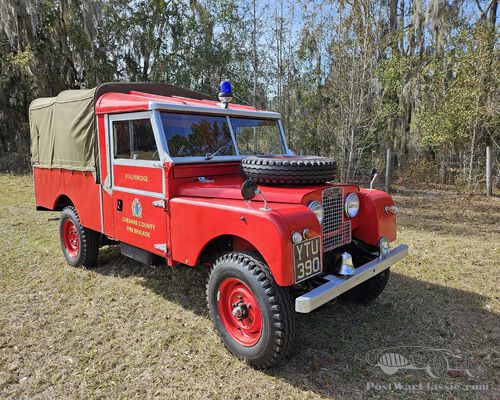
1957 Series 1 Land Rover Fire Engine + Coventry Climax Godiva Fire Pump
Betsy was used by Cheshire Fire Service (UK) from 1957 to 1975. She was based at Hazel Grove and Stalybridge Fire stations. She comes with an exten..
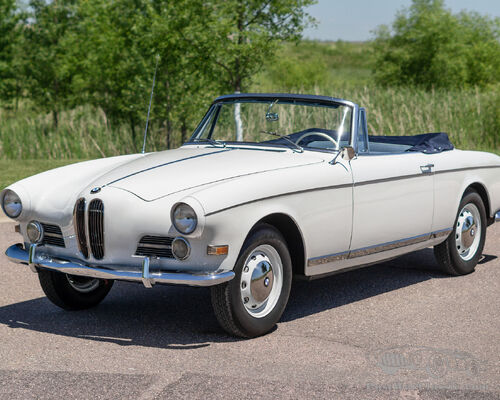
1957 BMW 503 Cabriolet (V8) – 1 von 13 für den US-Markt gebaut – #Matching Exemplar
1957 BMW 503 Cabriolet Serie 1Originaler Aluminium-V8 # MatchingOriginale Aluminiumkarosserie mit Werksprägungen1 von..