Das weltweite Magazin und der Marktplatz für Oldtimer-Enthusiasten – von Enthusiasten.





Der Markt; alle Post-War fahrzeuge zu verkaufen
Überblick ähnlicher Anzeigen MGB GT
-

1973 BMW 2002 Tii | Historics Auctioneers
BMW's director of product planning, Helmut Werner Bönsch and Alex von Falkenhausen, the designer of the BMW M10 engine, had both been owners of a 1600-2 (1602) and subsequently both had installed a two litre engine in their respective cars. Following the realisation that they had both made the same modification, they prepared a joint proposal to.. -
1973 Jensen Interceptor Mk. III | Historics Auctioneers
With the Interceptor’s introduction in 1967, Jensen switched from glass fibre to steel for its car bodies. Underneath, the preceding C-V8’s chassis, running gear and 6,276cc Chrysler engine remained substantially unchanged. With around 280bhp on tap, performance was more than adequate, The Motor magazine recorded a top speed of 140mph with 100mph a.. -
1972 Morris Mini 850 owned by World Champion Boxer ’Prince' Naseem Hamed | Historics Auctioneers
The history of this revolutionary motorcar is well known and its impact socially, culturally and mechanically is well documented. The Swinging Sixties, The Beatles, Twiggy and the Mini are inexorably combined to represent an era that is remembered with great fondness by many people. The production version of the Mini was demonstrated to the press i.. -
1972 Citroën SM | Historics Auctioneers
In 1961, Citroën began work on 'Project S', a sports variant of the revolutionary Citroën DS. As was customary for the firm, many running concept vehicles were developed, increasingly complex and upmarket from the DS. Citroën purchased Maserati in 1968 with the intention of harnessing Maserati's high-performance V6 engine technology to produce a tr.. -
1964 MG 1100 Mk. I | Historics Auctioneers
In 1962, a quite revolutionary new saloon was launched by BMC at the same time as the brand new MGB. Initially wearing the Morris badge, ADO16 was hot from the drawing boards of Alec Issigonis and Pininfarina. Offered in many guises by Innocenti, Morris, Riley, Wolseley, Vanden Plas and Austin, the AD016 was truly universal in its appeal. In line w.. -
1970 Triumph TR6 | Historics Auctioneers
The Triumph TR6 was manufactured for seven years from 1969 and by the time production came to an end in July 1976, it was the best-seller of the TR range. The bodywork closely resembled that of the previous model, the Triumph TR5, however the front and rear were squared off and all TR6s featured inline six-cylinder engines. For the US market, th.. -
1964 MG B Roadster | Historics Auctioneers
The MGB was launched in May 1962 to replace the MGA and was introduced as a four-cylinder roadster with a coupé added in 1965. It was a relatively modern design at the time of its introduction, utilising a monocoque structure instead of the traditional 'body-on-frame' construction used on both the MGA and MG T-types. The lightweight design reduced .. -
1971 Ford Capri Mk. I 3000E | Historics Auctioneers
Inspired by the success of the Mustang ‘Pony Car’ in the USA, Ford introduced a new model in 1968 for the European market, the Capri, ‘the car you’ve always promised yourself’. The Capri’s imaginative fastback styling was a relatively new departure for Ford, but beneath the lovely body design it remained typically Ford, sharing engines, gearboxes a.. -
1971 Jaguar E-Type Series III 2+2 Coupé | Historics Auctioneers
By the mid-1960s, the Jaguar E-Type was appealing to the man with a young family but who were restricted by the size of the current Jaguar E-Type Coupé and its open topped sibling. This prompted Jaguar to offer a third option in the form of a 2+2 Coupé. By adding nine inches to the wheelbase and two inches in height, it was then possible to fit a r.. -
1973 Jaguar E-Type Series III Roadster | Historics Auctioneers
By the mid-1960s, the Jaguar E-Type was appealing to the man with a young family but who were restricted by the size of the current Jaguar E-Type coupé and its open topped sibling. This prompted Jaguar to offer a third option in the form of a 2+2 coupé. By adding nine inches to the wheelbase and two inches in height, it was then possible to fit a r..


Ausgewählt
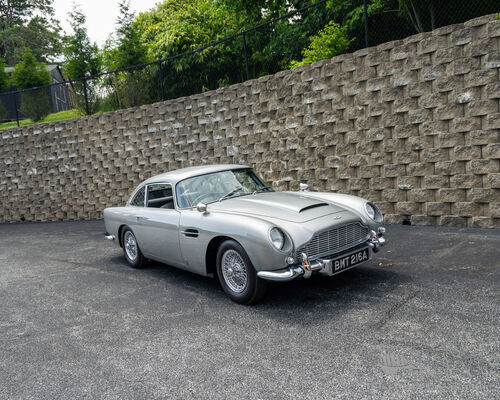
2020 Aston Martin DB5 Goldfinger Continuation
Angeboten bei RM Sotheby's, The Monterey Auction, 13.–15. August 2026. Schätzpreis: 1.000.000–1.500.000 USDEines von ledi..
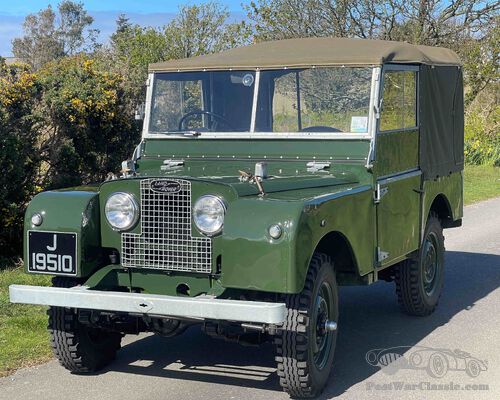
1952 Land Rover Series 1
Technische Daten:Marke und Modell: Land Rover Series !Baujahr: 1952Kennzeichen: Jersey-Zulassung
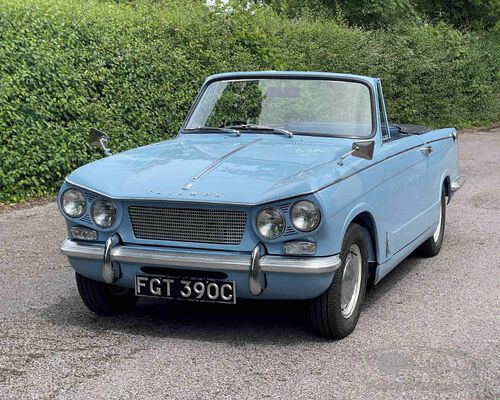
Triumph Vitesse 6 Convertible
Technische DatenMarke & Modell: Triumph Vitesse 6 ConvertibleBaujahr: 1965Zulassung: GroßbritannienFahrgeste..