Das weltweite Magazin und der Marktplatz für Oldtimer-Enthusiasten – von Enthusiasten.





Der Markt; alle Post-War fahrzeuge zu verkaufen
Überblick ähnlicher Anzeigen 1956 Jensen (Early) Interceptor Convertible
-

1950 Alfa Romeo 6C 2500 Sport Berlina by Pinin Farina | Donington auctions | Feb 19 - 25, 2024
Chassis no. 917077 Engine no. 927097 Following on from Jano’s legendary 6C and 8C models of the early 1930s and with war looming, Alfa Romeo launched an evolution of the earlier 6C 2300/2300B series at the Berlin Motor Show in February 1939. The new 6C 2500 featured a larger displacement 2443cc version of the classic in-line six-cy.. -
1973 Jensen Interceptor Restomod | Ascot Racecourse 2nd March 2024 Sale | Historics Auctioneers
Alan and his brother Richard Jensen first became involved with car design and construction in 1925. After World War II, Jensen kept itself afloat by producing bodies for other manufacturers, most notably Austin Healey, while producing its own stylish GTs in limited numbers. It was not until the Interceptor's arrival in 1967 that cars began to leave.. -
1959 Triumph TR3A | Ascot Racecourse 2nd March 2024 Sale | Historics Auctioneers
The Triumph TR3 was built between 1955 and 1962 and was usually supplied as an open two-seater, although an occasional rear seat and bolt-on steel hardtop were available as extras. It was powered by a 1991cc engine which initially produced 95bhp increasing to 100bhp at 5000rpm. The four-speed manual transmission could be supplemented by an overdriv.. -
1956 Austin Healey 100 / 4 BN2 to M-Specification | Ascot Racecourse 2nd March 2024 Sale | Historics Auctioneers
The direct steering of the Austin Healey combine the driving position, high-capacity engine and intoxicating exhaust note married together perfectly to offer the driver an experience like no other. The ‘100’ model designation cars were the first of the ‘Big’ Healey’s with shells produced by Jensen Motors and delivered to Austin’s Longbridge plant w.. -
1958 Jaguar Mk. I (3.4 Litre) | Ascot Racecourse 2nd March 2024 Sale | Historics Auctioneers
Launched in 1955, the Mk. I extended Jaguar's domination of the high-performance car market in Britain, slotting neatly into the Coventry firm's range alongside the big Mk. VII M saloon and the XK140 sports car. The medium size newcomer broke new ground for Jaguar, being its first model to employ unitary construction of the chassis/body. Jaguar's e.. -
1955 Land Rover Series I (86”) | Ascot Racecourse 2nd March 2024 Sale | Historics Auctioneers
Originally registered in 1955 to the Halesowen Engineering Company who converted vehicles for military contracts, it then began life as a Column Commander’s vehicle for the British Army whose job it was to lay communications cables across strategic territories. It eventually left the MoD before being restored in 2018. It was stripped and rebuilt wh.. -
1959 Lambretta 150 | Ascot Racecourse 2nd March 2024 Sale | Historics Auctioneers
Before World War II, Ferdinando Innocenti founded a successful engineering company making steel pipes and joints still used today for scaffolding and named it ‘Tubi Innocenti’. Just after the war he saw the potential for an economic means of transport and created the Lambretta, so called because its factory was in the east suburb of Milan, Lambrate.. -
1956 Bentley S1 | Ascot Racecourse 2nd March 2024 Sale | Historics Auctioneers
Successor to the R-Type, the Bentley S1 was introduced in 1955 with a whole new chassis; the car's wheelbase had been extended 3 to 123, and the luggage compartment was expanded. The S1 had softer suspension than the R-Type, with electrically controlled rear shock absorbers. Brakes had been improved, and the steering was lighter. This model marked .. -
1959 Mercedes-Benz 190 SL | Ascot Racecourse 2nd March 2024 Sale | Historics Auctioneers
In 1954, Mercedes displayed a concept version of the 190 SL at the New York Auto show alongside the 300 SL ‘Gullwing’. This concept came to market in 1955 as the 190 SL. A more approachable, less intense sports car compared to the record-breaking 300 SL Gullwing. While the 190 SL featured a carburetted 1.9 litre in-line four-cylinder engine compare.. -
1952 Riley RMB ‘Harrian Special’ | Ascot Racecourse 2nd March 2024 Sale | Historics Auctioneers
Despite producing some fine small saloons and sporting cars and carving out an enviable competition record for itself during the early 1930s, Riley had lost its battle to remain independent by the decade's end and became part of the Nuffield Organisation. Rileys of the immediate post-war years were, nevertheless, recognisable products of the 'old f..


Ausgewählt
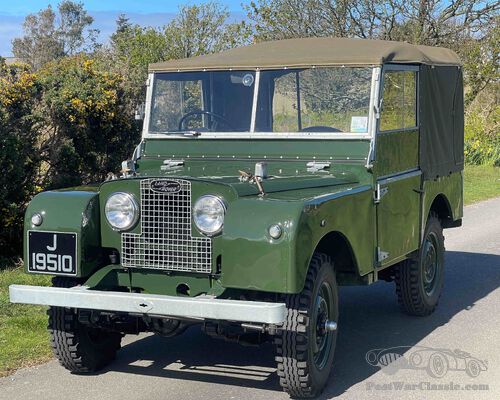
1952 Land Rover Series 1
Technische Daten:Marke und Modell: Land Rover Series !Baujahr: 1952Kennzeichen: Jersey-Zulassung
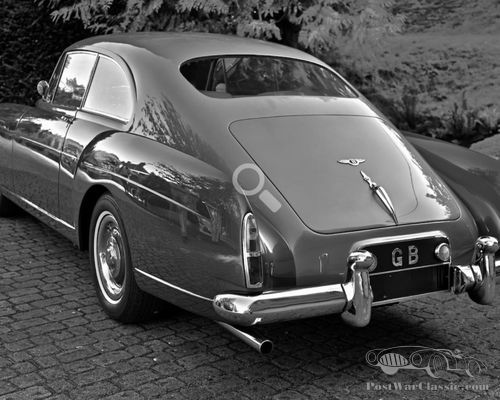
1957 Bentley S1 Fastback durch H.J. Mulliner.
1957 Bentley S1 Fastback by H.J. Mulliner.Frisch restauriertes und preisgekröntes Fahrzeug in neuwertigem Zustand. Es handelt sich um ein sp..
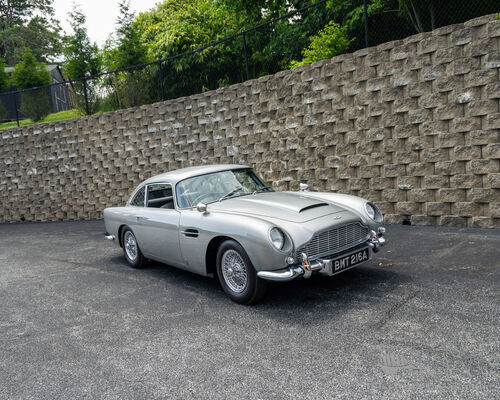
2020 Aston Martin DB5 Goldfinger Continuation
Angeboten bei RM Sotheby's, The Monterey Auction, 13.–15. August 2026. Schätzpreis: 1.000.000–1.500.000 USDEines von ledi..