Das weltweite Magazin und der Marktplatz für Oldtimer-Enthusiasten – von Enthusiasten.
Das weltweite Magazin und der Marktplatz für Oldtimer-Enthusiasten – von Enthusiasten.


Auswahl treffen
- Autos
-
Marke >>
-
Baujahr >>
-
-
Kategorie >>
-
Länder >>
- Motorräder
-
Baujahr >>
-
-
Standort >>
- Teile
-
Automarke >>
-
Hersteller >>
-
Kategorie >>
-
Länder



Der Markt; alle Post-War fahrzeuge zu verkaufen
Überblick ähnlicher Anzeigen 1948 Jaguar Mk IV 3½ litre
-

1988 Jaguar XJS Coupé (5.3 litre) | Ascot Racecourse | Historics Auctioneers | 25th September 2021
The Jaguar XJS was a luxury grand tourer produced from 1975 through to 1996 and replaced the E-Type. Although it never had quite the same sporting image, the XJS was actually more aerodynamic with the last one being produced on 4th April 1996; at that stage 115,413 had been produced during a 21 year production life. Originally, power came from the ..1988JaguarXJS Coupé (5.3 litre)VERKAUFT -
1958 Jaguar XK150 Drophead Coupé | Ascot Racecourse | Historics Auctioneers | 25th September 2021
Although having a family resemblance to the XK120 and XK140, the XK150 was radically modernised. A one piece windscreen replaced the split screen and the wing line no longer dropped as much over the doors. The bonnet was also widened, opened down to the wings and on the roadster, the bulkhead was moved back four inches to make the bonnet longer. In..1958JaguarXK150 Drophead CoupéVERKAUFT -
1973 Jaguar E-Type Series III 2+2 | Ascot Racecourse | Historics Auctioneers | 25th September 2021
There is no denying the legendary status that is enjoyed by the Jaguar E-Type, from its arrival on the motoring scene in 1961 until the final car was built in 1975, this sports car from Coventry had an impact that is still felt today. Even with its sportscar heritage, Jaguar depended on saloon vehicles for its survival and had developed its twelve-..1973JaguarE-Type Series III 2+2VERKAUFT -
1962 Jaguar E-Type Series I Coupé ‘Flat Floor’ (3.8 Litre) | Ascot Racecourse | Historics Auctioneers | 25th September 2021
Launched at the 1961 Geneva Motor Show, the Jaguar E-Type was nothing short of a revelation. With its heady blend of supercar performance, breath taking styling and low price tag, the newcomer left rivals reeling and customers clamouring, whilst early sportscar racing success at the hands of Graham Hill and Roy Salvadori amongst others helped cemen..1962JaguarE-Type Series I Coupé ‘Flat Floor’ (3.8 Litre)VERKAUFT -
1956 Jaguar Mk. I | Ascot Racecourse | Historics Auctioneers | 25th September 2021
Launched in 1955, the Mk. I extended Jaguar's domination of the high-performance car market in Britain, slotting neatly into the Coventry firm's range alongside the big Mk. VII M saloon and the XK140 sports car. The medium size newcomer broke new ground for Jaguar, being its first model to employ unitary construction of the chassis/body. Jaguar's e..1956JaguarMk. IVERKAUFT -
1995 Jaguar XJS Celebration | Ascot Racecourse | Historics Auctioneers | 25th September 2021
The Jaguar XJ-S is a luxury grand tourer produced from 1975 to 1996 and replaced the E-Type. Although it never had quite the same sporting image, the XJS was a competent replacement with better aerodynamics than the E-Type and was last produced on 4th April, 1996 by which time 115,413 had been produced during a 21-year production life. The car was ..1995JaguarXJS CelebrationVERKAUFT -
1993 Jaguar XJS Convertible | Ascot Racecourse | Historics Auctioneers | 25th September 2021
The Jaguar XJS is a luxury grand tourer produced from 1975 to 1996 and replaced the E-Type. The XJS was a competent replacement with better aerodynamics than the E-Type and was last produced on 4th April, 1996 by which time 115,413 had been produced during a 21 year production life. The car was re-engineered in May 1991 and renamed XJS (facelift). ..1993JaguarXJS ConvertibleVERKAUFT -
1963 Jaguar Mk. II (3.4 litre Manual O/D) | Ascot Racecourse | Historics Auctioneers | 25th September 2021
The Jaguar Mk. II was a medium size saloon built from 1959 to 1967 as a successor to the 2.4 and 3.4 models, manufactured between 1957 and 1959. The Mk. II was handsome, powerful and a good handling saloon which was offered with a choice of three six-cylinder twin cam engines; 2.4 litre, 3.4 litre or 3.8 litre. After the appreciation of the Mk. I, ..1963JaguarMk. II (3.4 litre Manual O/D)VERKAUFT -
1968 Jaguar 240 | Ascot Racecourse | Historics Auctioneers | 25th September 2021
In September 1967 the Jaguar Mk. II was re-labelled as the 240 and 340 compact saloons. They were interim models to fill the gap until the introduction of the XJ6 in September 1968. The 340 was discontinued on the introduction of the XJ6 but the 240 continued as a budget priced model until April 1969; its price of £1,364 was only £20 more than the ..1968Jaguar240VERKAUFT -
1975 Jaguar XJ6 Series II (4.2 Litre) | Ascot Racecourse | Historics Auctioneers | 25th September 2021
The first XJ was launched in 1968 a designation which has been used for successive Jaguar flagship models ever since and was also the last Jaguar saloon to have had the input of Sir William Lyons, the company's founder. The XJ6, using 2.8 litre and 4.2 litre straight six-cylinder versions of Jaguar's renowned XK engine, replaced most of Jaguar's sa..1975JaguarXJ6 Series II (4.2 Litre)VERKAUFT


Ausgewählt
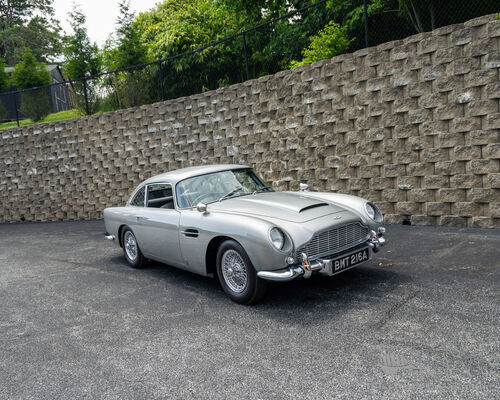
2020 Aston Martin DB5 Goldfinger Continuation
Angeboten bei RM Sotheby's, The Monterey Auction, 13.–15. August 2026. Schätzpreis: 1.000.000–1.500.000 USDEines von ledi..
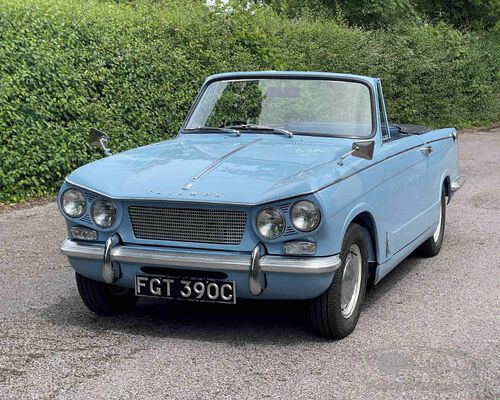
Triumph Vitesse 6 Convertible
Technische DatenMarke & Modell: Triumph Vitesse 6 ConvertibleBaujahr: 1965Zulassung: GroßbritannienFahrgeste..
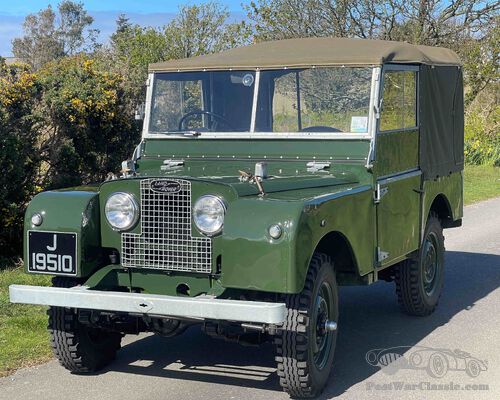
1952 Land Rover Series 1
Technische Daten:Marke und Modell: Land Rover Series !Baujahr: 1952Kennzeichen: Jersey-Zulassung